

Featured on Diario Ibiza / How I Translated an Artist’s Visual Language into an Edible Installation

How I created an edible interpretation for the opening of PICNIC by Pedro Pedro at Fundación La Nave Salinas
The exhibition PICNIC by Pedro Pedro explores the poetry of everyday objects—distorted, playful, and saturated with color.
When Fundación La Nave Salinas invited me to create an edible element for the opening, I saw it as an extension of this world.
My goal was to take the visual language of the paintings—their humor, density and playful imbalance—and explore how it could exist in taste, texture and three-dimensional space.

The Exhibition Context
PICNIC presents a universe built from everyday objects that feel at once ordinary and quietly surreal.
Pedro Pedro’s still lifes often begin with familiar scenes—plates, cut fruit, folded cloth, pastries—yet their proportions, colors and balance are subtly altered. In his hands, daily life becomes slightly theatrical: a lemon seems too shiny, a cake leans at an impossible angle, a table arrangement is crowded in a way that feels both humorous and intentional.
The exhibition occupies the wide, industrial interior of La Nave Salinas, a former salt warehouse now used as a space for contemporary art. Its scale and openness shape the way the paintings are experienced: the saturated colors stand out even more against the textured stone walls and the height of the industrial roof. The setting amplifies the sense that these everyday items have been lifted out of their routine context and placed somewhere more contemplative, more symbolic.
This summer, La Nave Salinas presented two exhibitions instead of the usual single annual show. One of them was PICNIC, which ran from 16 August to 31 October 2025.

PICNIC, in particular, centers on the tension between abundance and fragility: fruit that looks ripe enough to eat, cakes that appear fresh but also slightly unstable, arrangements that feel celebratory yet precariously balanced. The paintings play with the idea that the simplest moments—a snack, a table laid out, a slice of cake—contain their own quiet drama.
Understanding this atmosphere was essential before imagining any edible element for the opening. The installation needed to echo the tone of the exhibition: playful but intentional, abundant but not overwhelming, grounded in ordinary objects yet slightly off-balance in a way that invites people to look more closely.

Working with the Team
My involvement began with a series of conversations with Isaac Malca and the team at La Nave Salinas, whose curatorial vision for PICNIC was already remarkably clear. Héctor González also guided me through the nuances of Pedro’s paintings, offering context and details that helped shape my understanding before I began developing the edible concept. They had imagined the exhibition as more than a display of paintings; they wanted visitors to feel as though they had stepped into Pedro Pedro’s naughty world.
Their ideas were bold and playful—green picnic grass stretching across all of the gallery, and a long, elevated “picnic strip” installed inside the warehouse’s sunken central space. This lower-level platform, visible from above but inaccessible to the public, allowed them to stage an oversized, continuous still life that echoed the exaggerated compositions of the paintings. It immediately signaled that this exhibition aimed to invite people into a world rather than simply present one on walls.
As we discussed possibilities for the edible component, several directions emerged: a sculptural cake that could remain on display throughout the exhibition; a large-scale faux cake installation; or a dessert arrangement that interacted directly with the opening experience. What stood out to me in these early exchanges was their commitment to making the exhibition feel inhabited, tactile and delightfully unexpected. Their ambition was not decorative but experiential—transforming painted objects into something visitors could perceive spatially, almost scenographically.
This clarity of intention was energizing. It set the tone for how I would eventually approach the project as an extension of the exhibition’s narrative logic.

Approaching the Project as a Translation
When Lio Malca mentioned that the dessert table should feel tightly packed, it immediately struck me how aligned our instincts were. I had already been exploring ideas of imbalance and irregularity to echo the spirit of the paintings, and his comment made it clear that the team was not only open to this approach, but also genuinely committed to pushing the concept further.

That alignment was exciting. It confirmed that this was not a conservative brief; it was a project where experimentation was expected. I continued developing small “reverse-perspective” test cakes and colour studies—forms that leaned forward, stretched sideways, or disrupted symmetry—so the final table could carry the same lively tension while remaining something guests could interact with and taste.
Throughout this process, Isaac would listen with enthusiasm while staring up at the ceiling, imagining how could it might actually function. Those exchanges made the experimentation even more enjoyable. Everyone on the team was invested in turning painted fiction into something the public could physically encounter.

My proposal for the exhibition hinged on this idea:
Visitors would first see Pedro’s paintings, where real objects have been made slightly unreal, and then encounter the dessert table, where those unreal forms return to reality—edible, touchable, and momentarily alive before being shared. It became a loop between fiction and material, painting and taste, image and experience.

Color became its own challenge. What stood out to me was how the shadows sit on the edges of objects, and how the palette is vivid in a way natural food rarely is. To achieve this effect, every berry, slice of citrus, and flower was sculpted by hand in fondant. The blueberries were shaped one by one; the strawberries and lemon segments were painted with their internal textures; the buttercream piping was tested repeatedly to echo the irregular forms in his canvases.

Detailed Elements: Supporting the Illusion
One challenge quickly became clear: Pedro’s paintings rarely include plates. In practical terms, this meant the cakes couldn’t sit on cake bases without breaking the visual logic. To solve the problem, I used transparent acrylic bases that provided stability for transport while remaining visually invisible on the table—allowing the cakes to appear as if they were resting freely, just as they do in the artworks.
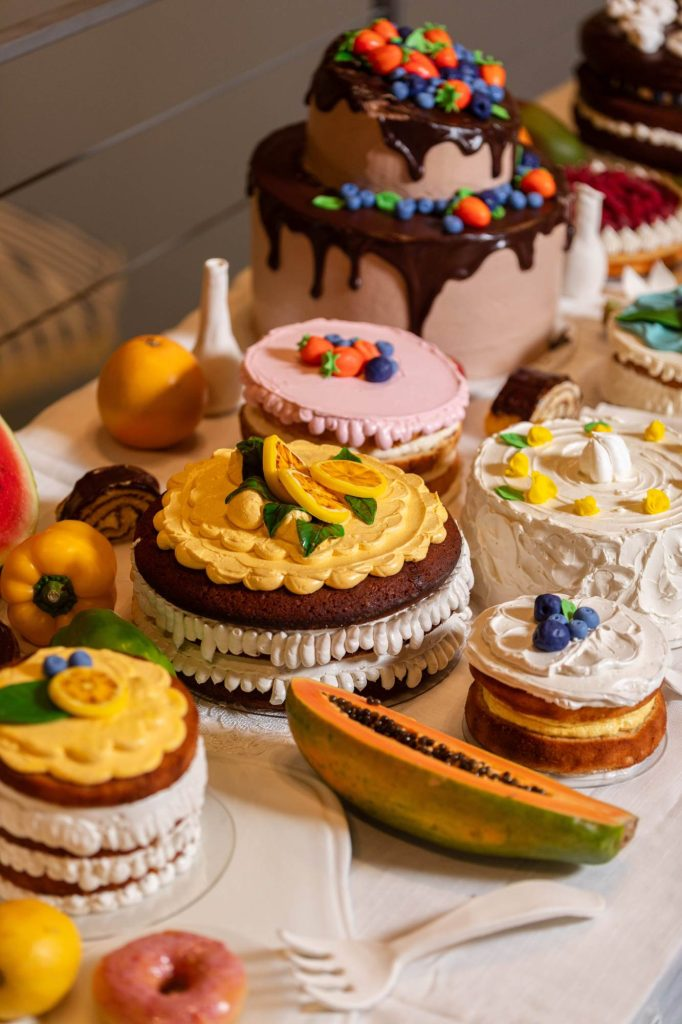
To echo the surrounding objects in the paintings, I sculpted a series of non-edible elements in white air-dry clay: the odd, elongated forks; the warped knife shapes; the flowing plate-like forms; even a few leaning vases. In the paintings these objects are vividly coloured, but for the installation I kept them all white so they could reference his fluid shapes without overpowering the cakes themselves. They functioned less as replicas and more as quiet reminders of the playful distortions within his compositions.

I also recreated some of the small, impossible piped details through meringue—shapes that, in the paintings, resemble exaggerated garlic bulbs or whimsical swirls that don’t exist in real pastry practice. Meringue allowed those forms to hold their structure while adding a light, crisp texture to the table.

Other edible components, such as cake rolls, cupcakes and small éclairs, were placed on tiny clear acrylic discs so they appeared unanchored, echoing the slightly weightless feeling of the paintings. Throughout the process, the most enjoyable decisions were the ones that balanced fidelity and interpretation—choosing when to borrow directly from the artwork and when to let the spirit of the paintings guide a new edible form.

What I Learned About Edible Media as Artistic Language
Working on PICNIC shifted the way I think about food as a medium. In pastry we often focus on technique, structure and finish, but in an exhibition context, food becomes something closer to sensory storytelling. Taste, texture and temperature move the experience beyond sight—collapsing the distance between artwork and viewer in a way static objects cannot.

An edible installation exists for a moment and then disappears, but that impermanence is part of its strength. Guests don’t just observe; they participate. They cut into a shape, share it, and become part of the work’s life cycle. That act turns the visual language of an artwork into something bodily and immediate.
This collaboration reminded me that
Food, when used intentionally, belongs in contemporary art contexts not as decoration but as language
Capable of extending the narrative of an exhibition, altering how people move through space, and creating encounters that are both intimate and collective. It is a medium that lives, shifts, and vanishes, leaving behind not an object, but a memory.
Exhibition
PICNIC — Pedro Pedro
Fundación La Nave Salinas, Ibiza
Artist
(pedropedrostudios.com)
Isaac Malca
Héctor González
Edible Installation / Dessert Table Design
Tammy — Kiss That Cake
Videographer
Photography(Official Exhibition Photos)
Fundación La Nave Salinas
How all of this unfolded in the actual exhibition space—and what happened on opening night—deserves its own story.


Comments